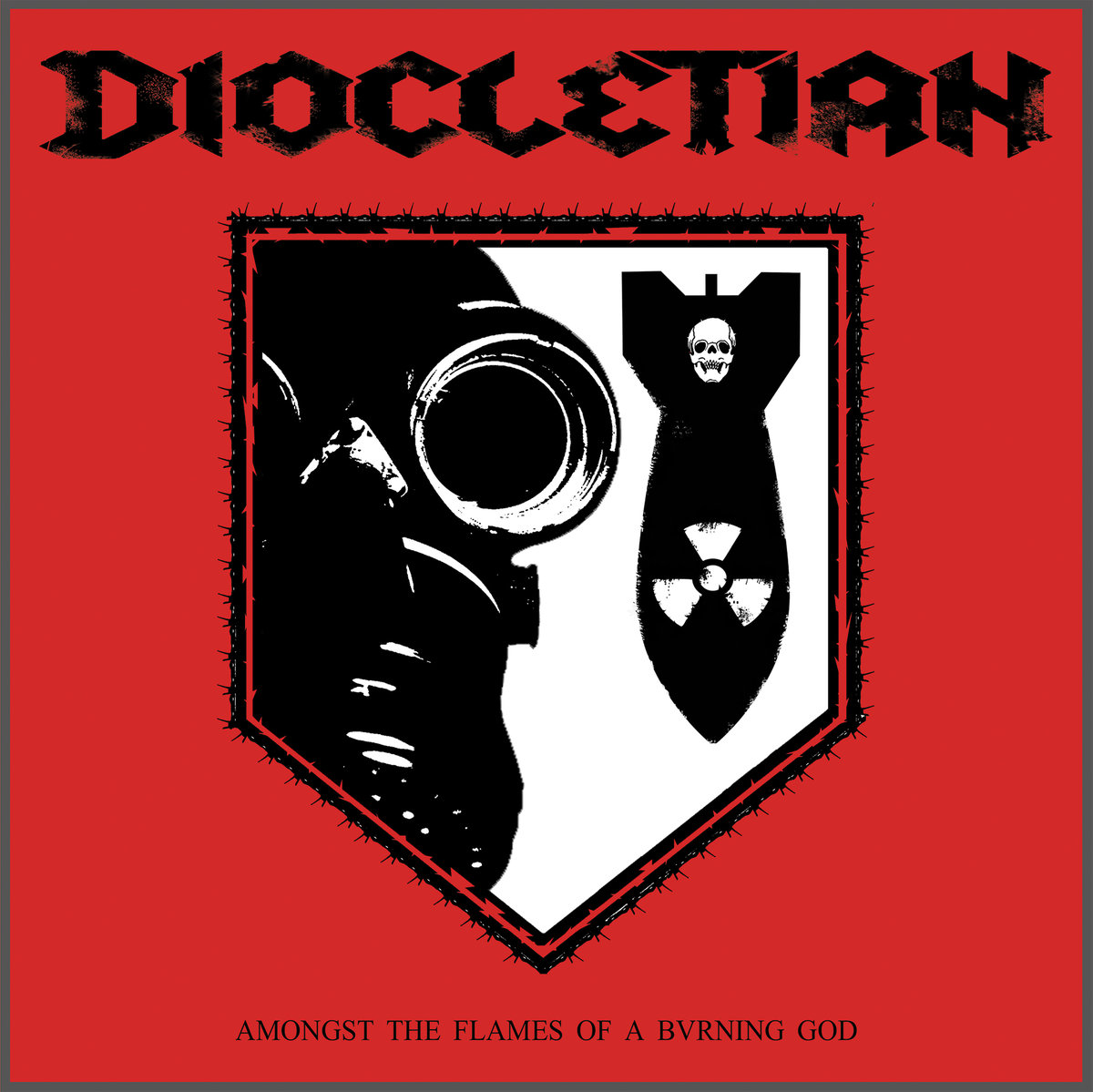
‘Amongst The Flames Of A Burning God’ is the first Diocletian album after its near death and then resurrection due to an 80% lineup transplant. Unlike previous albums, which crushed you by surprise under their monstrous treads, this Diocletian is a feral one which fills you with dread while it stalks you in full view then rips you apart with its huge predatory razor sharp teeth. Its nature pronounces itself through well crafted ‘tension and attack’ sections, sharpened by angry divebomb guitar solos along with dual high and low rhythmic lead vocals from R.W (ex Dawn of Azazel) and Impurath (ex Black Witchery).
At 27 minutes ‘Amongst The Flames’ is also the shortest Diocletian album. Far less polished than its predecessor, ‘Gesundrian’. Its production is closer to the raw filth of debut, ‘Doom Cult’. But with less emphasis on low end or prominence of drums in its mix. Something which enhances its aggressive nature.
The first of three standout tracks ‘Nuclear Wolves’ opens ‘Amongst The Flames’, setting the album’s tone in its full fierce impact. ‘Degenerate Swarm’ continues the theme before arriving at the king hitter of the album, ‘Repel the Attack’. “Repel...’ in my opinion is the strongest Diocletian composition to date. Its introduction to the album of descending riffs using either minor harmonies, chords, scales or a combination (I can’t tell for sure under the chaos) make it stand out along with it’s rhythmic chanted chorus. Something else that’s prominent on this album. On ‘Berserker Rites’ descending riff theme continues into ‘Invincibility through Strife’ and then ‘Procreate Strength’. ‘Plundered By Hyenas’ for some reason I can’t put my finger on, I’m brought back to reality and reminded that I’m listening to a band of human musicians recorded and mixed onto audio files. This is only a brief interlude however as album closer and final standout ‘Restart Civilisation’ drags us back into the post apocalyptic world of the hunter and the hunted with it’s opening doom and late appearance of Penderecki’s ‘Threnody for the Victims of Hiroshima’ (Google it) which also bids our existence goodbye in it’s dying screech.
A secret is in the hidden groove.
Much thought has gone into the presentation of 'Amongst The Flames Of A Burning God' Which sees the return of simplified imagery, also reminiscent of 'Doom Cult'
Each format has been made unique. Including the CD edition which is not featured here.
Critics could ask, is this a different Diocletian using the same name? To which I answer, no, it’s a different chapter of the same concept. A chapter which is in an intermediary stage. Building toward the brilliance of it’s final crescendo, which I hope leaves off from ‘Repel the Attack’.
After over a year of trying to nail this down, I can finally present to you the following in-depth interview with Shawn/Abomination and Alex/Occultorture "Bad News Brown" on the subject of all things WITCHRIST!
1) The latest Witchrist album 'The Grand Tormentor' has been heavily influenced by the eastern myth known as The Ramayana or Ramakien. Can you please give us a break down of how you have represented this story in the music and Lyrics of the album? For example what songs represent what parts of the Ramayana and how?
The majority of the tracks on the album relate to the ancient tale and also the murals contained at Wat Phra Kaew. Once again this is Witchrist's interpretation of the epic and the lyrics have been released with the album for this purpose.
Examples of murals contained at Wat Phra Kaew
2) On both 'The Grand Tormentor' and your previous album 'Beheaded Ouroboros ' a dark Hindu theme has featured in the art work, lyrics and even Sanskrit translations of the lyrics. Why have you chosen this theme? Is it something that Witchrist will continue with?
Having members of Asian hertiage does play some part in this decision, yes this will continue.
3) I'm aware that you have been working on new material. Could you please give some indications of what lyrical and musical directions this is headed in? Perhaps some titles if they exist yet? I'm interested to find out what other parts of eastern mythology you might be covering.
New material is currently being completed for the Antediluvian split 7" and perhaps another EP. The lyrical concepts are of a similar direction as the song "The Grand Tormentor" - ie. centred around a number of deities and their infliction of doom upon mankind. We will explore sources in the Puranas and certain sects of Buddhism to compile our most sinister material to date. No titles can be revealed as of yet as we are awaiting the finalisation of the material.
Note: While no description of the new music was given in this answer, I was given the privilege of hearing an untitled work in progress 6 minute track. What I can tell you is that it sounded like a more developed and epic version of the music music on 'The Grand Tormentor'. If this track is anything to go by, future Witchrist will top the current material and be something to get excited about.
4) Despite the eastern themes, the music of Witchrist is generally rooted in western death metal using traditional instruments. Although it was briefly touched on with the intro of "Adoration Of Black Messiah" on the 'Headless Oroborus' album, Have you considered utitlising eastern instruments, rhythms and or/melodies in the music of Witchrist? If not why? If so how and when will we hear it?
That is our way of presenting Witchrist, we use our own weapons and what we have ingrained in us. I listen to a select amount of Indian music and there is a depth to it which goes beyond simply playing an instrument and scale, you could describe this as Occult. Attempting to add these melodies to metal can result in mediocrity if not done correctly or without proper thought. We will use segments of Eastern music sparingly and with relation to that which is contained in the song.
5) One last question on the eastern occult theme. Obviously you have spent time researching the darker side of side of eastern religions. Have you at any time been a practitioner of any of these? for inspiration or otherwise? If so please elaborate.
I was raised in a traditional Hindu household, however as I grew older I was on a different path and stepped away from the more mainstream thought of Hinduism. Though the theory is a strong base for Witchrist I believe the traditional practices are best left to certain groups who follow the religion as a cultural aspect of society. The music of Witchrist will always be our ritual of darkness.
6) Witchrist is part of a group of bands self labeled as ‘Doom cult’. It currently only involves yourselves and Diocletian, but has included Vassafor and Sinistrous Diabolus. How did the 'Doom Cult' concept come about and why? What defines a ‘Doom Cult’ band? Are there likely to be any new edition to it’s fold in the future? If so who/what?
If you listen to Diocletian and Witchrist you have a glimpse at what Doom Cult is. We don't take applications.
7) That leads into a technical question about the 'Doom Cult' sound. Through frequenting the same rehearsal studio that both Witchrist and Diocletian use, I've noticed that between both bands you have a sizable collection of old NZ made 'Holden' amps. Why is that you have chosen to use these? What is it that they do that other Amplifiers don't? Are there any specific models of 'Holden' that you use? Why? Is there any other musical equipment (strings, speakers, pedals, guitars, drums etc) that is important to your sound? If so what and why?
The death tone achieved through these Holden valves are key factors in our choice, it is characteristic of Witchrist's sound. Both me and Occultorture have been using Holden in rehearsal for a long time, they are indestructible and noisy. Ultimately, the attitude dictates the direction of which the equipment is used.
8) Your recent video for 'Wasteland of Thataka' shows the band performing with images of skulls, smoke and a mysterious masked figure. After some brief research I have learned that 'Thataka' (Tatakā or Taraka (ताड़का) or Tadaka) is a 'Crow Demoness' in the Ramayana. She was cursed the loss of her beautiful physique and transformed hideous demonic creatures with a cruel, cannibalistic nature (Rakshasas). Thataka then inhabited a forest near the river Ganges that became known as the 'Forest of Thataka'. There she terrorized the people, devouring anyone who dared to set foot in that forest. After reading the lyrics to the song, my assumption is that the video symbolises 'Thataka' as the masked figure, her reign in the forest or 'wasteland' being depicted in the smoke and darkness, with the skull representing her many victims. How close am I?
Though the concept of the track may have a foundation with the Tataka demoness, the video and music should transcend thought. Therefore, the exact meaning behind the video is not easily described in words and it is best for the audience to interpret it on their own accord like you have done.
9) Witchrist and Doom Cult seem to have become quite a self sufficient working machine. Alex does all your artwork (Read a short interview with him on this subject at the end of this article), Cam does all the mixing, mastering and I believe soon the engineering of your recordings, Brendan directed your video and (as I understand) does all the managerial stuff and you run your own distro label 'Goat Gear' where among other things, your releases are available in NZ. Is there anything I've missed out? Was this something that was intended or has it come about naturally over time? What else would you take control of if you had the opportunity? Why?
Yes you could say we are organized chaos. As for expansion... Why not? This is only the beginning.
As you have mentioned we all contribute certain characteristics to the Cult, I still believe it is essential to place the individual aside for the bigger picture, greater purpose. in the case of Doom Cult our intentions are to invest in what we truly believe is worthy of our time and energy.
10) Witchrist have an interesting stage aesthetic consisting of minimal lighting, smoke, covered faces and hoods. What mood or feeling are you intending to evoke with this? What was the original inspiration of the the hoods? Is their anything that you'd like to add to your stage presentation that you haven't yet, or would if their were no parameters restricting you? If so what?
We embody the spirit of our music, its a permanent mindset and our intensity does not waiver in anything we do. We do not NEED to have particular clothing in order to do this.. if we discover the hoods are unsuitable we will discard them.... The music should be the ultimate component of the RITUAL. Though at the same time bands with weak stage presence only degregate themselves., perhaps this means they should not be creating that type of music.
11) Thanks Shawn for an enlightening interview into the world of Witchrist. Is there anything else you'd like to say in closing? Perhaps a plug for 'Goat Gear' if you want?
I chose to ask Alex/Occultorture "Bad News Brown" the following questions so as to get a first hand insight into Witchrist cover art, but also to explore his art as a whole. Continue reading...
1) Could you please give us a brief rundown on how you started out as an artist, leading up to becoming the well known underground metal cover artist you are now? What were some of your key influences that lead to you developing the unique style you have now?
I've been drawing since I can remember, but never studied art formally. Only after studying graphic design did I realize that a 9-5 job wasn't for me. I followed my own path and somehow arrived where I am now.
Influences are infinite, but the seed for it all was seeing stippling for the first time (probably on a Metallica or Napalm Death record) and thinking it was such a painstakingly detailed technique, more extreme than simple hatching. I had to learn how to do it. Other than this I don't think much about having a particular style.
2) Obviously being a member of Witchrist, the band gets to be in the privileged position of having lots of highly detailed, quality internal and external album art. What research have you done into the eastern and hindu imagery that adorns Witchrist album covers? How long did it take you to complete all of the art work for “The Grand Tormentor” and particularly “Beheaded Ouroboros”? What techniques and tools do you use in your art?
Each album would've taken somewhere between 6 and 12 months each whilst also working on commissions. I read several important 'eastern' texts in research for the art but really only really took base concepts to make my/our own. Traditional depictions were perverted and combined with other ideas related or otherwise. As mentioned above stippling is the main technique, although more line work and black ink washes have come into play as of late.
3) You recently traveled to the US to take part in an art exhibition “Invocation I”. Which along with your self featured the work of AntiChrist Kramer and a number of other Metal cover artists. How did it come about? Tell us about how it went and what the highlights were. What did you gain from it?
Invocation was my first exhibition as well as my first time visiting the States so it was an all round amazing experience. Eternal gratitude to Rick/DB Think Tank. It was a great insight in Hollywood and connectivity of it all. I met a lot of great people, saw a lot of great art and ate a lot of great food, but it was still just a taste. I'll be back.
4) What are your favorite pieces of your own artwork? Ultimately where would you like to go with your art long term?
I aim to work on bigger and more diverse projects in terms of size, audience and medium. It doesn't matter if it involves metal or even music at all, as long as I'm able to create. And as for favourites it's hard to say but the Mitochondrion art is up there as well as The Grand Tormentor. I see every new drawing as a step forward mind you and 2013 will hold the biggest steps yet.
5) What should people do if they would like to get you to do art work for them? Any last comments?
Unlike previous ‘Doom Cult’ releases, ‘The Grand Tormentor’, which is the first Witchrist release on Osmose Productions, has an instantaneous appeal. I found myself nodding my head to it from the first listen on my car stereo. In the past I’ve found them (recordings from the Doom Cult) to be slow growers. Where the previous Witchrist album ‘Beheaded Ouroboros’ was more a barrage of unrelenting war chaos, ‘The Grand Tormentor’ is like of a dirty ‘Immolation’, an ‘Incantation’ that’s been living rough for a few weeks without Clean clothes or a shower, or maybe even a ‘Disma’ that’s staggered out of the Megalith covered in coal dust and the rolled in a rotting goat carcass and then in dust before showing up at home and been told piss off outside until it’s squirted down with a high powered hose.
From start to finish the album flows nicely. The opening tune ''Into the Arms of Yama' is a nine minute building doom epic which eventually (around minute 6) breaks into death metal aggression. This simplistic yet brutal Neanderthal assault continues in song number 2, the title tune, and again in ‘Meditation for Sacrifice’ which then progresses down into doom dirge. This is followed by ‘Wasteland of Thataka’ which at 1:36 is the shortest blast of hatred on the release. That hatred is blasted again in an extended barrage on 'Exile'. ‘The Tomb’ opens with a taste of ‘Autopsy’ and early ‘Pungent Stench’ styled slow dirge riffs with hammer on hammer off tails which progresses into an intense up-tempo rhythm that continues into ‘Tandava’, then to the catchy fist pumper that is ‘Cast into Fire’. Album closer ‘Funeral Lotus’ wraps things up in much the same way it started with an epic nine minute doom number.
Special comment must be given to the drum sound. Rather than the modern death metal triggered drum sound which to my ears sounds like a cross between a Geiger counter and someone farting loudly on a plastic chair, you can actually feel the low rumble of the kick drums more than you can hear them (although you can still clearly hear them), Which in my view is how they are supposed to be. Additionally the vocals sit in the music as more of an accompanying instrumental texture rather than dominating growls, this compliments the album nicely.
‘Annihilation Rituals’, The first Diocletian release on Osmose productions, is a compilation album featuring the almost* complete chronological discography of every release prior to the ‘Doom Cult’ album. This includes ‘Demo I’, the ‘Decimator’ mini album, the ‘Chaos Rising’ side of the split LP with ‘Denouncement Pyre’ and the ‘Sect of Swords’ 7” ep. I have most of these releases already, but it really is good and enlightening to be able to listen to all of this in one sitting. It’s also timely as it captures every release featuring the vocals and lead guitar of Logan Muir up until he departed from the band the first time around and sets the scene for his recent returned on bass and lead vocals.
Although this isn’t new music I’d have to say that it’s my favourite Diocletian release, as there are some really powerful and varied songs featured. Particularly on the opening tracks from the first demo, the only thing I previously didn’t own by the band, which shows why Diocletian were hot property in the underground Metal scene when it came out in 2005. I’d go as far as saying that although some of the official studio recordings of the demo tracks featured later on ‘Annihilation Rituals’ are strong, that these early versions stand out as being superior in their raw chaotic forms. In saying that though, I do have a soft spot for the extended Outro on the “Chaos Rising” Version of “Doom Cult”. In a chat conversation I had with Atrociter/B. Southwell (Guitar) some time ago he mentioned that among other things they were looking back at ‘Demo I’ as a guide for the direction they wanted future material to be like. I wonder what this will mean?
Next to the demo tracks, two other titles stand out for me. These are “Master/Enslaver” from Decimator and “Gesundrian” from the Denouncement Pyre split. There are a couple of reasons for this. The first being that unlike other Diocletian material they are based around effective, simplistic, intense tension building melodies (If “melody” is the right word to use) and the second being that this is a musical concept that they don’t seem to have revisited in later material. I do note that both tunes get a second rendition on the upcoming/imminent Weregoat split which will be interesting to check out.
As with ‘Witchrist - The Grand Tormentor’ , the mastering on ‘Annihilation Rituals’ by Cam S (Skin pounder for both Diocletian and Witchrist) brings a consistency and brings the best out of everything.
Also a special note must also be made of the excellent job Logan Muir has done as graphic artist on the layout of this release, as he also did for the recent vinyl releases of the ‘War Of All Against All’ album.
This is an essential release for anyone yet to check out Diocletian, is wanting to plug gaps in their collection, or who just wants to listen to it’s entire content without having to get up and change records every few minutes. Get now Kvnts!
*The cover of “All that Remains” Bolt Thrower from “Decimator” is not included here.
After selling several thousand albums internationally on both CD and vinyl formats and playing shows in Southeast Asia, Ireland, across Europe and most recently the US, Diocletian are one of New Zealand music's dirtiest secrets. A secret that New Zealand Music it's self probably doesn't even know about and most likely the way the band like it.
Diocletian play 'War Metal' , a style which was founded, or at least popularised by bands such as Order from Chaos and Canada's Blasphemy (The later of which Diocletian member VK is currently the live session bassist for). To describe the sound of War Metal and Diocletian in particular, picture a giant Nuclear armed tank, 50 meters high with each of it's tracks the width of a four lane motorway. Riding on top of it of it is a giant repulsive non human multi tentacled being barking out orders in an unknown violent language to the thousands of solders marching in front of it. The Solders are oversized black clad gas mask wearing figures that may or may not be human, but are definitely of some sort of mutant barbarian genetic strain. Each one of them is carrying a 50 cal. machine gun with a chainsaw bayonet revved up full bore. Then imagine that image channeled through Guitars, Bass, drums and vocals in order to get an idea of what Diocletian sound like.
Among all this chaos it's hard to pin point exactly what it is I like about this album more so than it's predecessor 'Doom Cult'. It could be the a more naturally focussed feel that's come from the band being together for a longer amount of time (Honed chaos if you will), the more upfront definition/bite in the production, the evolved sound of the vocals, the seemingly more pronounced heavy riffs or maybe a combination of all theses things.
To give a graphic comparison, refer to the previous described image of said War machine. If the Doom Cult version were destroying everything in it's path, then this version would be doing the same thing except it would be placing extra focus on strategic targets to ensure greater efficiency in it's destruction.
Listening to a Diocletian album is an experience rather than a collection of songs. "War Of All Against All" is not recommended for the weak hearted, but is a necessity for those with an Iron will, black blood and a lust for war.